Two million couples said “I do” in the United States in 2025, and a disproportionate share of them chose June, July, or August to do it — a pattern that holds steady year after year as warm weather, longer days, and lush landscapes pull couples toward outdoor ceremonies. With the average wedding now costing $34,000 and the median couple inviting 117 guests, summer weddings sit at the intersection of high stakes and high logistics: every weather forecast, every shade structure, every gust of wind matters. The good news? Today’s couples have more design tools, smarter venues, and better data than any generation before them. The challenge? Outdoor garden venues are now the #1 venue choice for the second year running, which means competition for the prettiest dates, the best vendors, and the most photogenic backdrops has never been fiercer.
This guide is built for the modern summer wedding — whether you’re hosting 40 guests at an intimate vineyard estate or 200 at a sprawling waterfront property. We’ll walk through every decision that’s specific to a warm-weather, open-air celebration: how to scout a venue with a real backup plan, how to design a menu that survives 85-degree heat, how to dress your wedding party for both photos and physics, and how to keep your guests genuinely comfortable from ceremony to last dance. Pull up a chair — and maybe a sparkling water with cucumber — because the next eight months are about to get a lot more organized.
Key Takeaways
- Romantic outdoor garden venues remain the #1 wedding venue choice for the second consecutive year, followed by rustic farms, barns, and ranches — book 12-18 months ahead for peak summer dates.
- Average summer wedding cost is $34,000 with $292 spent per guest; venue, food, and weather contingency planning consume nearly 60% of the budget.
- Hybrid indoor/outdoor venues with retractable glass panels, covered courtyards, and movable walls are now expected by 2026 couples — not optional.
- Sage green is the dominant color of 2026 weddings, used by 30% of couples; pastels and bold prints outpace neutral palettes in summer guest attire by 8x.
- Smaller, more intentional guest lists are surging: 40-80 guests is now the “magic number” for destination and intimate summer weddings, with personalization replacing tradition.
- Daytime ceremony, evening reception is the rising format — sunlight ceremonies transition into glow-lit, climate-controlled receptions to beat afternoon heat peaks.
- Backup weather plans are mandatory: 67% of summer weddings face at least one weather disruption (heat, rain, or wind); tents, fans, and shade structures should be booked alongside the venue.
Table of Contents
- Why Summer Weddings Win — and What Makes Them Different
- Choosing the Right Outdoor Venue
- Building a Realistic Summer Wedding Budget
- The Summer Wedding Timeline (12-Month Countdown)
- Designing the Ceremony: Themes, Florals, and the Aisle
- Reception Planning: Menus, Bars, and Climate Control
- Guest Comfort: The Detail That Makes or Breaks Your Wedding
- Weather Contingency: Plan B (and Plan C)
- Dress Code, Wedding Party Wardrobe, and Photography
- Frequently Asked Questions
- Conclusion and Related Reading
1. Why Summer Weddings Win — and What Makes Them Different {#why-summer}
Summer weddings have a gravitational pull. Long daylight hours mean ceremonies can run from 4 p.m. into golden-hour photo windows without the rush of an early sunset. Gardens are at peak bloom. Travel is easier for guests, with kids out of school and most workplaces operating on summer schedules. And outdoor venues — the dominant trend of the year — are designed to shine in exactly these months.
But what makes a summer wedding work is exactly what makes it harder than any other season:
- Open-air design means the weather is part of your guest experience, for better or worse.
- Peak demand means premium dates (especially Saturdays in June and the first half of July) book out 12-18 months in advance.
- Vendor pricing spikes during peak season — caterers, florists, and photographers often charge a 10-25% summer premium.
- Logistics multiply outdoors: power for catering, restrooms, lighting, sound, shade, parking, and weather contingency all require dedicated planning that an indoor ballroom would handle automatically.
The 2026 Summer Wedding in Numbers
| Metric | 2026 Reality |
|---|---|
| Average U.S. wedding cost | $34,000 |
| Average per-guest cost | $292 (up $8 from 2024) |
| Average guest count | 117-132 |
| Couples impacted by economic factors | 85% |
| Couples that increased (not cut) spending | 77% of those adjusting |
| Top venue choice | Outdoor garden |
| Dominant color | Green (53% of weddings); sage green (30%) |
| Peak engagement months | December (13%), May, June (11% each) |
The takeaway: couples are spending more per guest while inviting fewer of them. Summer weddings in 2026 are intentional, design-forward, and unapologetically experiential.
2. Choosing the Right Outdoor Venue {#choosing-venue}
Venue is your single largest decision. It locks in your date, your style, your guest count, and roughly 30-40% of your budget. For an outdoor summer wedding, the venue selection process is fundamentally different from an indoor one.
The Six Outdoor Venue Categories
Garden and Estate Venues
The current #1 choice. Manicured grounds, established landscaping, and built-in romantic backdrops. Often include indoor backup spaces.
- Pros: Photo-ready, weather-resistant, low decoration needs.
- Cons: High demand, premium pricing, often have strict end times due to neighbors.
- Best for: 75-200 guests, classic and romantic aesthetics.
Farms, Barns, and Ranches
The #2 trend nationally. Combine outdoor ceremony space with covered reception barns — a built-in weather plan.
- Pros: Hybrid indoor/outdoor flow, rustic photo opportunities, often more relaxed timeline rules.
- Cons: Distance from cities means transportation logistics; bugs and dust are real.
- Best for: 100-250 guests, country/rustic/boho aesthetics.
Vineyards and Wineries
Vineyard estates are surging in 2026, especially among couples seeking privacy and a “destination feel” without leaving the country.
- Pros: Built-in beverage program, gorgeous photo backdrops, often have on-site coordination.
- Cons: Beverage minimums can be steep; July heat in wine country can exceed 95°F.
- Best for: 50-150 guests, refined and food-forward weddings.
Beach and Waterfront Venues
Lakes, rivers, and oceans deliver spectacle, but they also deliver wind, sand, and tide considerations.
- Pros: Stunning ceremony backdrops, natural cooling, memorable setting.
- Cons: Wind is a constant threat (florals, hairstyles, sound systems all suffer); permits often required.
- Best for: 30-120 guests, intimate and adventurous celebrations.
Mountain and Cabin Retreats
Cliffside retreats, mountain cabins, and alpine meadows are explicitly named in 2026 trend reports as standout venue types.
- Pros: Cooler summer temperatures, dramatic photography, all-in destination feel.
- Cons: Altitude affects guests (and alcohol); access is limited; vendor travel fees.
- Best for: 40-100 guests, adventure-minded couples.
Backyard and Private Property
The ultimate in personalization — and the ultimate logistical exercise.
- Pros: Total creative control, budget flexibility, deeply meaningful setting.
- Cons: Everything is rented (chairs, tents, tableware, restrooms, generators); permits, insurance, and noise ordinances apply.
- Best for: 30-150 guests, couples comfortable with project management.
Venue Vetting Checklist
Before you sign a contract, verify:
- Indoor backup space — does it actually fit your full guest count, or only the ceremony?
- Climate control — fans, misters, retractable panels, or AC for the reception?
- Power capacity — can it handle DJ, catering, and lighting simultaneously?
- Restroom-to-guest ratio — minimum 1 per 25 guests (build-in or rental)
- Sound restrictions — what’s the cutoff time, and how does that affect your timeline?
- Vendor flexibility — open list, exclusive list, or preferred list?
- Setup and teardown windows — same-day or day-before access?
- Liability and insurance — what does the venue cover; what do you need to add?
- Cancellation and force majeure clauses — heat advisories, hurricanes, wildfires
- Parking and shuttle plan — especially critical for rural and remote venues
- Service animal and pet policies — if your dog is in the ceremony
- Photography permits — some public gardens charge separately
- Catering kitchen access — full kitchen, prep kitchen, or tented field kitchen?
Booking Lead Times for 2026 Summer Dates
| Date Type | Recommended Lead Time |
|---|---|
| Saturday in June | 12-18 months |
| Saturday in July | 12-15 months |
| Saturday in August | 10-14 months |
| Friday/Sunday | 9-12 months |
| Holiday weekends (Memorial Day, July 4, Labor Day) | 14-18 months |
| Weekday weddings | 6-9 months |
If you’re reading this in late spring and want a 2026 summer wedding, weekday and Sunday options will be your best path to top-tier venues.
3. Building a Realistic Summer Wedding Budget {#budget}
The $34,000 average wedding cost is exactly that — an average. Your number will swing based on guest count, venue type, and geography. Use this allocation as a starting point and adjust based on your priorities.
The Outdoor Wedding Budget Allocation
| Category | % of Budget | Notes |
|---|---|---|
| Venue and ceremony fees | 30-40% | Higher for all-inclusive resorts; lower for backyards |
| Catering and bar | 25-30% | $80-180 per person depending on style |
| Photography and videography | 10-12% | Book early — top photographers fill summer 18 months out |
| Florals and decor | 8-12% | Outdoor gardens reduce floral needs |
| Attire and beauty | 5-8% | Wedding dress, suit, hair, makeup |
| Music and entertainment | 5-8% | DJ vs. live band; ceremony musicians |
| Stationery and signage | 2-3% | Invitations, menus, programs, signs |
| Rentals (tent, chairs, lighting, restrooms) | 8-15% | Outdoor-specific surcharge |
| Weather contingency | 3-5% | Tents, fans, heaters, umbrellas |
| Transportation | 2-4% | Shuttles for guests, especially at remote venues |
| Wedding planner | 8-15% | Full-service planners are common at $25K+ budgets |
| Buffer / unexpected | 5-10% | Always — always — include this |
Why Outdoor Adds 10-20% to Your Budget
Indoor ballrooms include things you don’t see on the invoice — chairs, tables, dance floor, climate control, restrooms, lighting, power, security. Outdoor venues either don’t have these, or include only some. Build the gap into your line items:
- Tent: $3,000-$15,000 depending on size and style (clear-top tents trend at the higher end)
- Restroom trailer: $1,500-$5,000 for a wedding-grade unit
- Generator: $500-$2,000 for catering and lighting
- Climate control (fans, misters, AC): $500-$5,000
- Field lighting (string lights, market lights, uplighting): $1,500-$8,000
- Dance floor rental: $500-$2,500
Where to Save Without Looking Cheap
Couples who are spending more per guest while inviting fewer of them are essentially trading volume for quality. You can apply the same logic at the line-item level:
- Sunday or Friday wedding: Save 15-30% on venue and vendor pricing.
- Daytime reception: Brunch and lunch costs 30-40% less than dinner.
- In-season florals: Hydrangeas, dahlias, garden roses, and zinnias are summer staples and cheap.
- Family-style or food-station service: 20-30% cheaper than plated.
- Skip the videographer at the rehearsal dinner.
- Use ceremony florals at the reception: Repurpose arch arrangements as sweetheart-table or bar decor.
Where Not to Cut
- Photography. The wedding ends; the photos are forever.
- Catering quality. Guests forgive a lot, but they don’t forget bad food.
- Climate control. A miserable, sweaty reception will be remembered.
- Day-of coordination. Even if you DIY-plan, hire a professional for the wedding day itself.
4. The Summer Wedding Timeline (12-Month Countdown) {#timeline}
A summer wedding compresses certain decisions and stretches others. Here’s a practical countdown for a June, July, or August wedding.
12+ Months Out
- Set a realistic budget with both partners
- Draft an estimated guest count (this drives venue size)
- Tour 5-8 venues, ideally on weekends to see them in summer light
- Sign venue contract and pay deposit
- Book photographer and videographer
- Book wedding planner (if applicable)
- Send save-the-dates if more than 30% of guests are traveling
9-12 Months Out
- Book caterer, bar service, and cake/dessert vendor
- Book florist and finalize aesthetic direction
- Book DJ or live band (and ceremony musicians)
- Book officiant
- Choose wedding party and ask formally
- Begin shopping for wedding attire
- Book hotel room blocks for out-of-town guests
- Apply for marriage license requirements research
6-9 Months Out
- Order wedding dress and bridal party attire (allow 4-6 months for alterations)
- Book hair and makeup trial and contract day-of
- Reserve transportation: shuttles, getaway car
- Reserve all rentals (tent, restroom trailer, lighting, dance floor)
- Plan honeymoon
- Order invitations and stationery
- Book engagement photo session
3-6 Months Out
- Send invitations (8-12 weeks before for summer; 12+ for destinations)
- Finalize menu, including kids and dietary options
- Order favors, signage, and ceremony programs
- Confirm cake design and tasting
- Schedule rehearsal and rehearsal dinner
- Take engagement photos
- Book honeymoon flights and lodging
- Choose wedding party gifts
6-8 Weeks Out
- Final dress fitting
- Apply for marriage license (varies by state)
- Confirm all vendor contracts and timelines
- Provide caterer with final guest count
- Submit final song lists to DJ/band
- Finalize seating chart
- Print menus, programs, and signage
- Pre-pay vendors and prepare day-of envelopes/tips
2 Weeks Out
- Confirm weather forecast and trigger Plan B if needed
- Final headcount to caterer and venue
- Organize day-of timeline document for vendors
- Prepare wedding-day emergency kit
- Last manicure/pedicure/haircut
Day Before
- Rehearsal and rehearsal dinner
- Drop off venue items (escort cards, signs, favors)
- Hydrate, eat, sleep — in that order
Wedding Day
- Hair and makeup
- Photographer arrives for getting-ready shots
- First look (optional)
- Ceremony
- Cocktail hour
- Reception
- Send-off
5. Designing the Ceremony: Themes, Florals, and the Aisle {#ceremony-design}
Personalization is one of the most enduring 2026 wedding trends — couples are prioritizing experiences that reflect their story, interests, and values, replacing rote tradition with intentional design. Your ceremony is where this matters most: it’s the only ten minutes of your wedding day that’s purely about the two of you.
Color Palettes That Define 2026 Summer Weddings
Green is the dominant color of the year — used by 53% of all weddings, with 30% of couples specifically opting for sage green. For summer specifically, expect:
| Palette | Vibe | Best With |
|---|---|---|
| Sage and ivory | Soft, romantic, timeless | Garden venues, terracotta vessels |
| Sage and dusty blue | Coastal, breezy | Waterfront and lake weddings |
| Cream, blush, and butter yellow | Warm, sun-drenched | Vineyard and orchard venues |
| Terracotta and rust | Earthy, desert-inspired | Mountain and desert weddings |
| Lavender, sage, and white | Provincial, fragrant | English garden and farm venues |
| Bold tropical (fuchsia, coral, palm green) | Festive, statement-making | Beach and resort weddings |
Pastels and bold prints are mentioned over 8x more often than neutral or minimalist looks for summer 2026 — so don’t be afraid of color, especially in florals, linens, and stationery.
The Ceremony Arch (or No Arch)
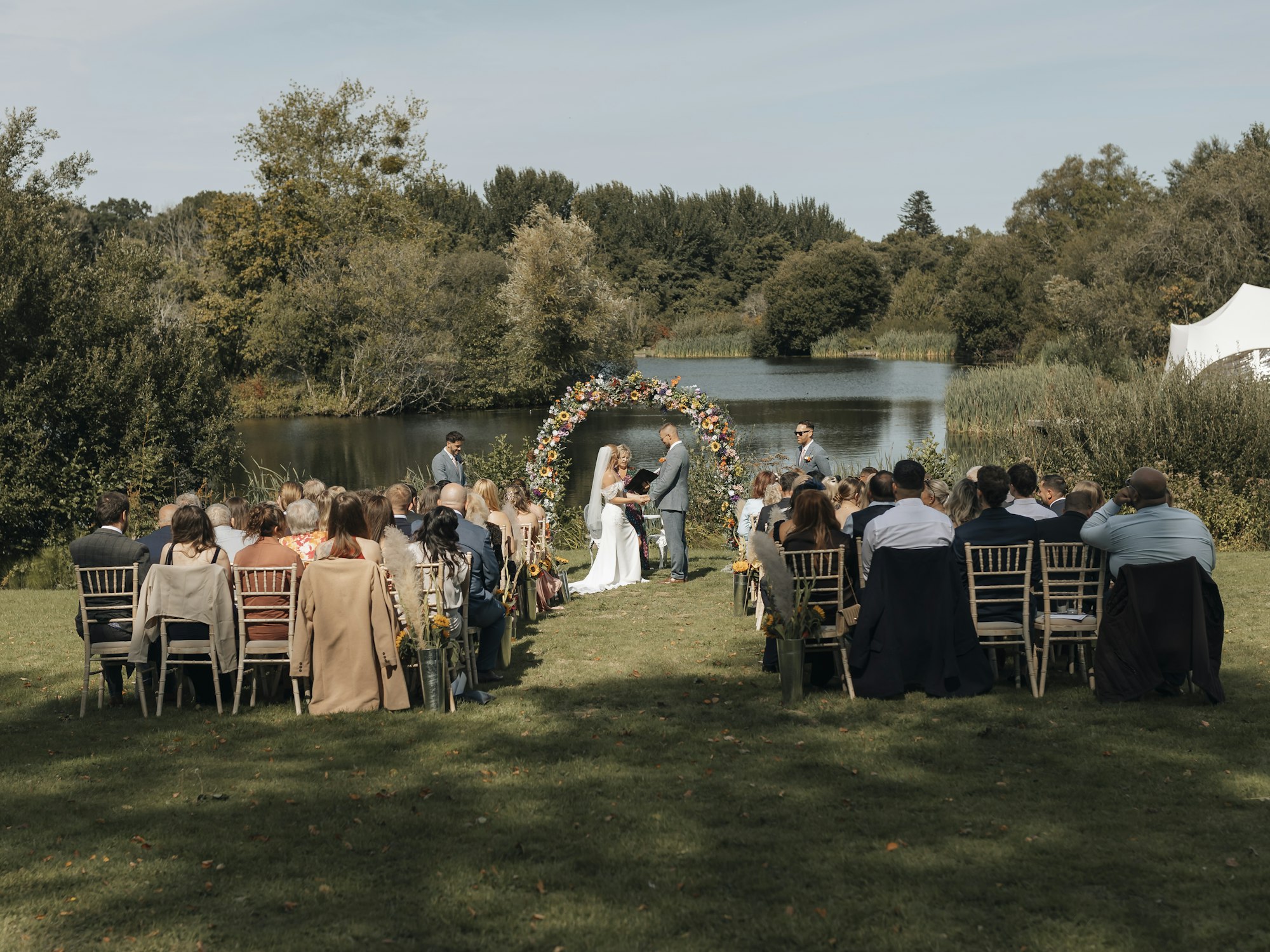
The arch has become the centerpiece of outdoor ceremonies. Options:
- Floral arch: Full coverage, $1,500-$5,000
- Greenery arch with focal florals: $800-$2,500
- Triangular geometric arch: Modern, $400-$1,200
- Round moon gate: Architectural statement, $600-$1,500
- Live grown structure (existing tree, gazebo): Free with the venue
- No arch: Use the natural landscape as your backdrop
Outdoor garden venues let you skip the arch entirely. A vineyard row, a mountain ridge, or a lakefront horizon does the visual work for you — and saves $1,500+.
Aisle Decor and Seating
- Chairs: Crossback (wooden), Chiavari (gold or silver), or ghost (acrylic) chairs are standard. Avoid white folding chairs unless you’re decorating heavily.
- Aisle markers: Lanterns, low floral arrangements, single bud vases, or shepherd’s hooks with greenery.
- Aisle runner: Optional outdoors — wind and grass make traditional fabric runners impractical.
- Petals or natural materials: Rose petals, lavender, or wildflowers work, but check venue rules.
Ceremony Music and Sound
Outdoor sound is hard. Wind, distance, and ambient noise all eat into clarity. Solutions:
- Lavalier mic for officiant, handheld for vows.
- Wireless speakers placed at front and middle rows.
- Live ceremony musicians (string trio, harp, acoustic guitar) carry beautifully outdoors but still need amplification at 50+ guests.
- Sound check 60 minutes before guests arrive — wind direction can shift everything.
Personalized Ceremony Elements
Couples are leaning into personalization. Some ideas:
- Hand-fastening or unity rituals tied to family heritage
- Friend or family-officiated ceremony (legal in most states)
- Bilingual or multilingual readings
- Incorporating pets in a meaningful role
- Vow-writing workshop together with a coach (yes, that’s a real service)
- Pause for a moment of silence for loved ones who’ve passed
- Live painting of the ceremony in real-time as a keepsake artwork
6. Reception Planning: Menus, Bars, and Climate Control {#reception}
The shift toward daytime ceremonies with evening receptions is gaining ground specifically because it solves the hardest problem of summer weddings: heat. A 4 p.m. ceremony in golden light flowing into a 7 p.m. reception under string lights and a cooling breeze is the new template.
Reception Format Options
| Format | Pros | Cons |
|---|---|---|
| Plated dinner | Traditional, elegant, predictable | Expensive ($120-200+ per person), slower service |
| Family-style | Warm, communal, conversation-driving | Requires larger tables; not allergy-friendly |
| Stations / heavy apps | Encourages mingling, dietary flexibility | Can feel less formal; logistics-heavy |
| Buffet | Cost-effective, customizable | Lines, less polished, takes space |
| Food trucks | Trendy, fun, photogenic | Weather-dependent, capacity limits |
| Brunch / lunch | 30-40% cheaper, daylight photos | Earlier ceremony required |
Summer-Smart Menu Choices
Hot weather changes everything about menu planning. Mayo-based salads, dairy sauces, and chocolate desserts that look great at 70°F can become liabilities at 90°F.
Best for summer:
- Citrus-marinated grilled proteins (chicken, fish, lamb)
- Seasonal grain salads (farro, freekeh, couscous)
- Cold soups (gazpacho, chilled cucumber-yogurt)
- Charcuterie and crudités stations
- Stone fruit and berry desserts
- Lemon, olive oil, and rosemary cakes (more heat-stable than buttercream)
Risky in summer:
- Heavy cream-based sauces
- Mayo-based salads on outdoor buffets
- Buttercream cakes in direct sun (use Italian meringue or fondant)
- Chocolate truffle favors (they melt in welcome bags by noon)
The Summer Wedding Bar
Hydration is the difference between a happy reception and a medical event. Plan for at least 1.5 drinks per guest per hour for the first two hours, then 1 per hour after, and double the water and non-alcoholic options vs. a winter wedding.
Trending summer 2026 bar concepts:
- Curated cocktail menus (3-4 signature drinks instead of a full open bar) — saves 25-40% on bar costs
- Frozen cocktails (frozé, frozen palomas, daiquiris) — built-in cooling
- Spritz bars (Aperol, Hugo, elderflower) — low-ABV, summer-coded
- Non-alcoholic mixology (NA spritzers, infused waters, kombucha on tap) — non-drinking guests now expect parity, not afterthought
- Coffee + espresso bars at the end of the night for the drive home
Climate Control: The Hidden Reception Hero
Hybrid indoor/outdoor venues with movable walls, retractable glass panels, and covered courtyards are now expected by 2026 couples — not a perk. If your venue doesn’t have built-in climate control, layer in:
- Industrial fans (rented from event suppliers, not box stores) — $50-$150 each per day
- Misting fans for cocktail areas — most effective in dry heat
- Portable AC units for tented receptions — $400-$1,500
- Shade sails or umbrellas for cocktail hour
- Hand fans as wedding favors — practical and photo-friendly
- Heaters for late evenings — even July nights cool 20°F after sunset in many regions
7. Guest Comfort: The Detail That Makes or Breaks Your Wedding {#guest-comfort}
A common piece of feedback from couples after their summer wedding: “The thing my guests remember most was how comfortable they were.” Comfort isn’t a soft variable — it’s the variable.
The Welcome Box
For destination and out-of-town guests, welcome boxes have evolved from “nice to have” to baseline. For a summer wedding, include:
- A reusable water bottle
- Sunscreen (SPF 30+)
- Bug spray or natural insect-repelling wipes
- A folding fan
- A local snack
- A schedule and address card with directions and shuttle info
- Aspirin or ibuprofen (post-rehearsal-dinner currency)
The Ceremony Comfort Kit
Place at the back of the ceremony (or hand to guests as they arrive):
- Programs printed on paper fans
- Parasols for the ceremony in direct sun
- Bottled water (chilled, in a galvanized tub with ice)
- Sunscreen on a stand
- Bug spray station
- Tissues
- Flat sandals in size assortment for guests in heels (especially on grass)
The Reception Comfort Kit
Place in restrooms or near the dance floor:
- Bobby pins, hair ties, and dry shampoo
- Stain remover wipes
- Pain reliever (acetaminophen, ibuprofen)
- Antacids
- Mints
- Deodorant wipes
- Blister bandages
- A small sewing kit
- Phone chargers (Lightning, USB-C, micro-USB) — yes, all three
Accessibility Considerations
Outdoor venues are notoriously hard on accessibility. Audit your venue for:
- Wheelchair access from parking to ceremony to reception
- Cobblestones, gravel, or grass that block walkers and heels
- Shaded seating reserved for elderly and pregnant guests
- Restroom accessibility (especially for trailers)
- Hearing accommodations (request lavalier mics for clarity)
- Dietary accessibility (allergens, vegan, kosher, halal)
The Kid Plan
Kid-friendly weddings need their own infrastructure:
- A separate kids’ table with crayons, coloring books, and snacks
- A kids’ menu (chicken tenders, pasta, fruit) — caterers usually charge 50% of adult pricing
- A designated quiet space (shaded tent corner, indoor room)
- Babysitting service for the reception (hire pros — never burden a guest)
- Ear protection for toddlers near speakers
- An early end time for kids if reception runs late
8. Weather Contingency: Plan B (and Plan C) {#weather}
Weather-ready options and climate-control solutions are now standard for 2026 weddings — not just considerations. The question isn’t if you’ll need a backup plan, it’s when you’ll trigger it.
The Three Weather Scenarios
| Scenario | Probability | Response |
|---|---|---|
| Heat (>85°F) | High in June-August | Misting fans, tent shade, hydration stations, schedule adjustments |
| Rain | Moderate | Tent, indoor backup, umbrellas |
| High wind (>15 mph) | Common at beaches, ridges, lakes | Weight all decor, anchor florals, secure linens, mic adjustments |
The Tent Decision Framework
A tent is your most expensive contingency tool — but skipping it on a 60% rain forecast is the kind of mistake that ruins weddings.
Always tent if:
- Your guest count exceeds the indoor backup capacity
- The forecast shows >40% precipitation in the 7-day window
- The venue is in a region prone to summer thunderstorms (Southeast, Midwest)
- You have a destination wedding where guests can’t reschedule
Tent type guide:
- Pole tent (traditional, peaked): Cheapest; needs grass surface and stakes
- Frame tent (no center poles): More flexible footprint; works on hard surfaces
- Sailcloth tent: Romantic translucent fabric; pricier
- Clear-top tent: Trending in 2026; lets daylight and stars in; needs cooling
The Decision Day
The hardest call in summer wedding planning is when to trigger the backup plan.
- 7 days out: Begin watching forecast trends, not point forecasts.
- 72 hours out: Make the call on tent rentals (rental companies need 48-hour lead time).
- 24 hours out: Make the call on indoor vs. outdoor ceremony location.
- Day-of, 4 hours before ceremony: Final call. Once decided, communicate to guests via text, group chat, or wedding website.
Build your communication plan in advance: a pre-drafted “ceremony moved indoors” text saves panic at the moment of decision.
Hurricane and Wildfire Clauses
If your venue is in coastal Florida, Carolinas, Gulf states, California, or the Pacific Northwest, your contracts should explicitly cover:
- Force majeure provisions for hurricanes and wildfires
- Refund or reschedule terms in writing
- Travel insurance for both you and your guests (mention it in the welcome packet)
9. Dress Code, Wedding Party Wardrobe, and Photography {#wardrobe}
Summer weddings place real demands on what you and your guests wear. Heat, humidity, and outdoor surfaces shape every wardrobe decision.
Wedding Dress Considerations
- Fabric: Chiffon, organza, silk crepe, and lace breathe; satin and heavy duchess satin are punishing in heat.
- Silhouette: A-line and slip dresses outperform ballgowns in summer.
- Train length: Cathedral trains and outdoor grass surfaces are not friends. Consider a bustle for the reception.
- Layering: Detachable sleeves or a covering for ceremonies in religious spaces.
- Color: Off-white, ivory, and champagne are all photographing beautifully against summer greenery.
Suit and Groom Attire
- Fabric: Linen, cotton, and lightweight wool blends; avoid heavy wool.
- Color: Light blue, sage, beige, ivory, and dove gray dominate 2026 summer weddings.
- Footwear: Loafers and lighter shoes work for outdoor venues better than oxfords.
- The two-look option: Some grooms wear a jacket for the ceremony and shed it for the reception.
Wedding Party Considerations
For bridesmaids and groomsmen on hot days:
- Mismatched dresses in the same color family — easier to flatter every body type.
- Avoid synthetic fabrics that don’t breathe.
- Open-toed shoes, sandals, or block heels for women on grass.
- Hidden bobby pins to anchor hairstyles in wind.
Guest Dress Code
Spring and summer wedding guest attire is trending toward color-forward, seasonally responsive dressing — pastels and bold prints are mentioned over 8x more often than neutral or minimalist looks. Be specific on your invitation:
- Garden party: Tea-length or midi dresses, suits in light colors
- Beach formal: No heavy fabrics; loose silhouettes; no stiletto heels
- Cocktail attire: Knee-length to midi dresses, suits without ties optional
- Black tie optional: Allow guests to choose; many will go formal anyway
- Black tie: Tuxedos and floor-length gowns — yes, even in summer
Summer Wedding Photography Tips
Outdoor light is your biggest asset and your biggest variable. Coordinate with your photographer on:
- First look timing: Avoid harsh midday light (11 a.m.-2 p.m.).
- Ceremony orientation: Couples should face away from harsh sun (no squinting).
- Golden hour: Block 30-45 minutes for couple’s portraits in the hour before sunset.
- Backup indoor or shaded location for portraits if heat is severe.
- Touch-ups: Build a 15-minute window before the reception entrance for makeup and hair refresh.
- Drone shots: Drone use requires venue permission and FAA registration.
10. Frequently Asked Questions {#faq}
How early should we book a summer 2026 wedding venue?
If you want a Saturday in June or early July, you should be booking 12-18 months in advance. Sundays and Fridays book about 9-12 months out. Weekday weddings — increasingly popular for cost-conscious couples — can sometimes be booked 6 months out, even at top venues.
What’s the average cost of a summer outdoor wedding in 2026?
The U.S. average is $34,000 with a median of $18,231. Summer outdoor weddings typically run 10-20% above comparable indoor weddings due to rentals (tent, restrooms, climate control, lighting). Per-guest costs average $292 in 2025, with realistic ranges of $250-$350 depending on region and style.
Should we have an indoor ceremony backup or just trust the forecast?
Trust the forecast for the date, but always have a written backup plan. Outdoor ceremonies in summer face a 60-70% chance of at least one weather variable (heat, rain, or wind) that affects the original plan. Even if the forecast is clear, build in shade, hydration, and a covered Plan B.
How many guests should we plan for at a summer wedding?
Average is 117-132 guests, but the trend is clearly toward smaller, more intentional weddings. For destination and intimate weddings, 40-80 guests is now considered the magic number. Guest count drives venue size, catering cost, and rental volume — every decision flows from this number.
What’s the best month for a summer wedding in 2026?
June is the most popular for weather and aesthetics — but also the most expensive and most competitive. July offers similar weather with slightly more availability. August often delivers the best value, though heat can be extreme in Southern and Southwestern states. Many couples are now choosing late May or early September to capture summer beauty without peak pricing.
How do we keep guests cool at an outdoor summer wedding?
Layer your cooling strategy: shade structures (tents, sails, umbrellas), industrial fans, misting fans, hydration stations every 50 feet, hand fans as favors, frozen cocktails, parasols at the ceremony, and a daytime ceremony / evening reception schedule that avoids the 1-3 p.m. heat peak.
Are tents required for outdoor weddings?
Tents aren’t legally required, but they are practically required for any outdoor wedding without an equivalent indoor backup space. Even on perfect-weather days, tents provide shade, lighting infrastructure, and a contained acoustic environment. For 2026 weddings, sailcloth and clear-top tents are trending alongside traditional pole tents.
What summer wedding mistakes should we avoid?
The five most common: (1) underestimating the cost of outdoor rentals, (2) skipping or under-planning weather contingency, (3) under-staffing the bar and service team, (4) choosing fabrics that don’t breathe, and (5) not having a final-decision deadline for indoor vs. outdoor on wedding day.
11. Conclusion and Related Reading {#conclusion}
A summer wedding rewards the couples who plan deliberately. The data is clear: garden venues are the top choice, sage green is the dominant color, hybrid indoor/outdoor venues are now expected, and personalization is replacing tradition across nearly every category. But the day itself is shaped by a hundred smaller decisions — the chair you pick, the water station you place, the fabric of your suit, the cutoff time on your tent rental — that quietly determine whether your wedding feels effortless or chaotic.
Your timeline is your most important tool. Start with the venue, build the budget around it, and then layer in vendors, design, and contingency in that order. Don’t skimp on photography, climate control, or day-of coordination. Do save where it doesn’t show — Sunday vs. Saturday, lunch vs. dinner, in-season florals, and curated bar menus. And always plan for weather as if it’s coming, because in summer it usually does.
Most of all: remember that 2026’s most enduring wedding trend is intentionality. The couples who build their summer wedding around their actual lives — their values, their friendships, their food, their music — are the ones who walk out of the reception knowing they got it exactly right.
Related Articles
- Wedding Planning Timeline — A month-by-month chronological framework for any wedding season
- Bachelor and Bachelorette Party Planning Guide — Plan the pre-wedding celebration that sets the tone
- Outdoor Festival Planning — Expert tips on managing any large outdoor gathering, applicable to outdoor weddings
Ready to start planning? Browse our wedding event templates to find a starting framework for invitations, RSVPs, seating, and guest communication — all customizable for your summer celebration.